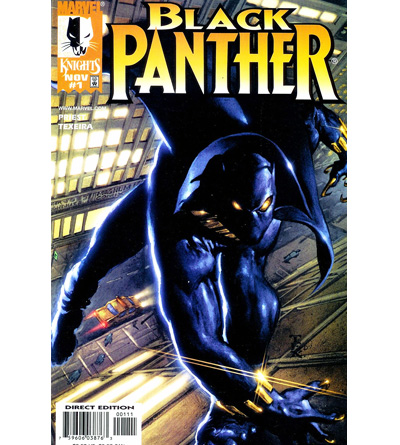
Black Panther #1 (1998)
Writer: Christopher Priest
Pencils: Mark Texeira
A few years ago, I was eating lunch on a patio in Germany with people from Malaysia, Japan, India, Belgium, Canada, and China. No, this isn’t one of those cheesy 80’s racist jokes about: “three guys walk into bar”, it was a professional lunch for the ol’ day job. The conservation bounced toward movies. Specifically the “Marvel Cinematic Universe”. Everybody said that “Black Panther” was their favorite of the bunch and they all loved the concept of Wakanda. Then I talked about how there were rumors of the movie being developed as far back as the mid-80’s. Before we knew it, we all spent over an hour talking about all things Black Panther, and were late to our afternoon meetings.
Hey…fun lunch. I remembered how, growing up, Black Panther and Wakanda seemed to me like an “only in comics” thing that wouldn’t easily translate to a movie screen and become globally popular. Yet here I was, halfway around the world and EVERYBODY knew about who T’Challa was. I was happy to be wrong. “T’Challa” was even a question (answer) on “Jeopardy!” In the 1980’s, it seemed improbable that Wakanda, T’Challa, and even M’Baku would become part of the worldwide pop culture zeitgeist.
So when did this phenomenon start? Well, Black Panther’s first appearance in Fantastic Four #52 in the 1966 would be the official answer. However, Black Panther was something of a B-list or even C-list super hero. He was usually a guest star (in “Defenders”, “Marvel Team-Up”), a team member (“Avengers”) or in an anthology title (“Jungle Action”). While he did have a fairly short-lived solo title in the mid-70’s, by the mid-80’s, he was rarely seen. There were rumors of a new relaunched title or mini-series, circa 1984. I want to say the words “Black Panther” even crawled onto the famous Marvel subscription ads in late 1984. Yet, as the X-Treme 90’s hit, Black Panther had been around for almost 30 years and was still a B-lister (including his role in “Fantastic Force“). There were loose rumors of a movie (with Wesley Snipes attached), but they didn’t seem to go beyond that.
For whatever reason, Marvel finally decided to give him an ongoing solo title in 1998. Marvel, the company, was still going through bankruptcy, yet was still trying to throw a lot of stuff at the wall, in hopes of it sticking. Ka-Zar, Maverick, Alpha Flight, Heroes for Hire and many more were given new FIRST ISSUES without much hype or build-up. With nothing really to lose, in November 1998, Black Panther #1 opened with one of the more unexpected splash pages of all time:
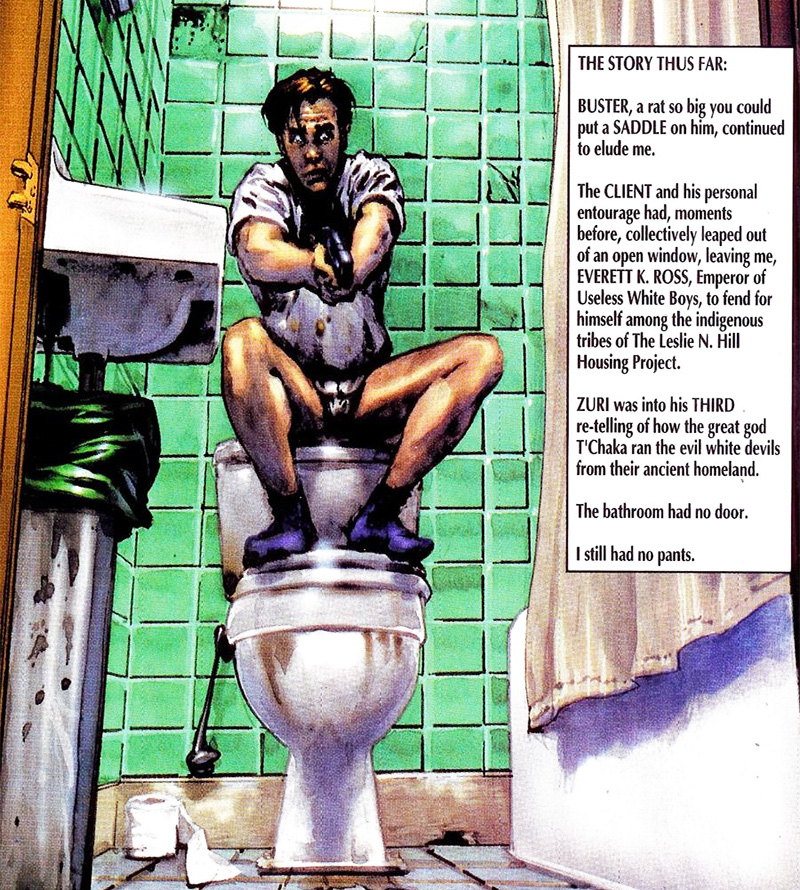
The guy on the throne is Everett K. Ross. He works for the US government’s Office of the Chief of Protocol (OC) and this story; and subsequently the series, it told mostly through his point-of-view. His boss, Nikki, has just assigned him to escort the diplomat T’Challa on his latest visit to the US and New York City. Ross thought that T’Challa was “just a guy in a kitty costume”, but as the story unfolds in a non-linear fashion, he’s nuts-deep in more shenanigans than he ever expected.
Wait.. non-linear fashion? Yeah, this was 1998 and Pulp Fiction and Quentin Tarantino were still very much things. Both of those terms get blatantly name-dropped in this comic, with no bones about it. It works well, as it adds a (then) contemporary “cool” vibe to Ross’s comic relief antics, which in themselves are a good vehicle to introduce the casual reader into the world of Black Panther. It’s a slick way to combine the craziness of Marvel’s world — and T’Challa’s specifically– into the ordinary.
Along the way, we see that T’Challa isn’t just a back-up Avenger or guest-star. He’s kind of a bad tushy kicker. He’s not only a very strict international political leader, but he can deal with everything from ethnic conflicts in Wakanda or would-be gangsters in NYC.
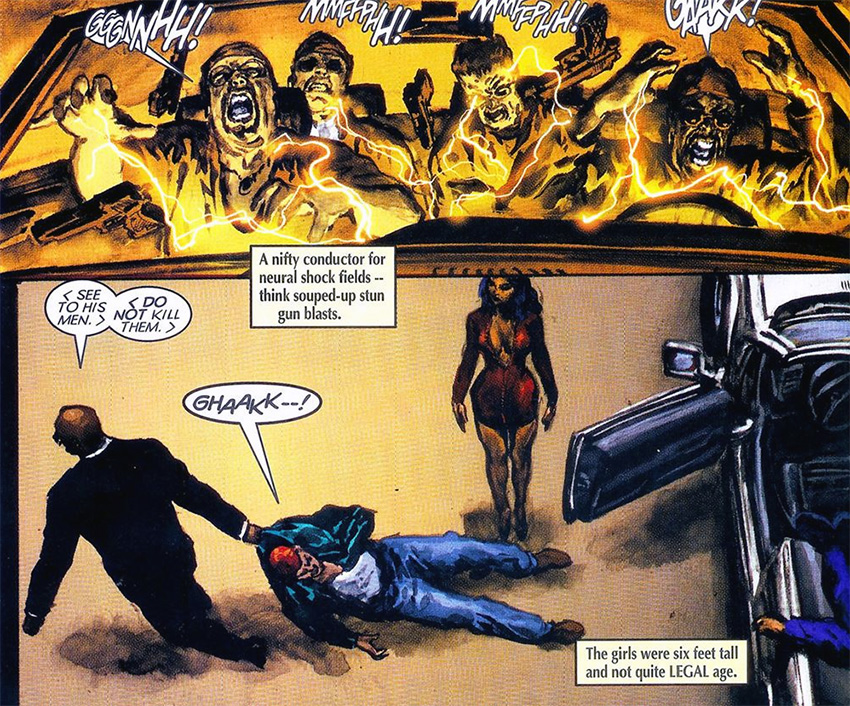
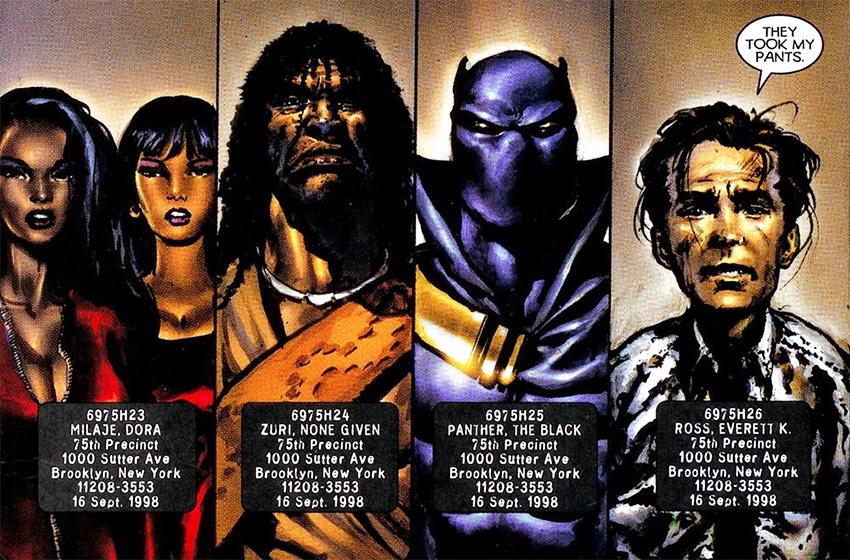
Yup, T’Challa also brought along his Dora Milaje honor guard and his advisor Zuri. I thnk this was the first time the Dora Milaje characters– Okoya and Nakia- – had ever been included in Black Panther’s world.
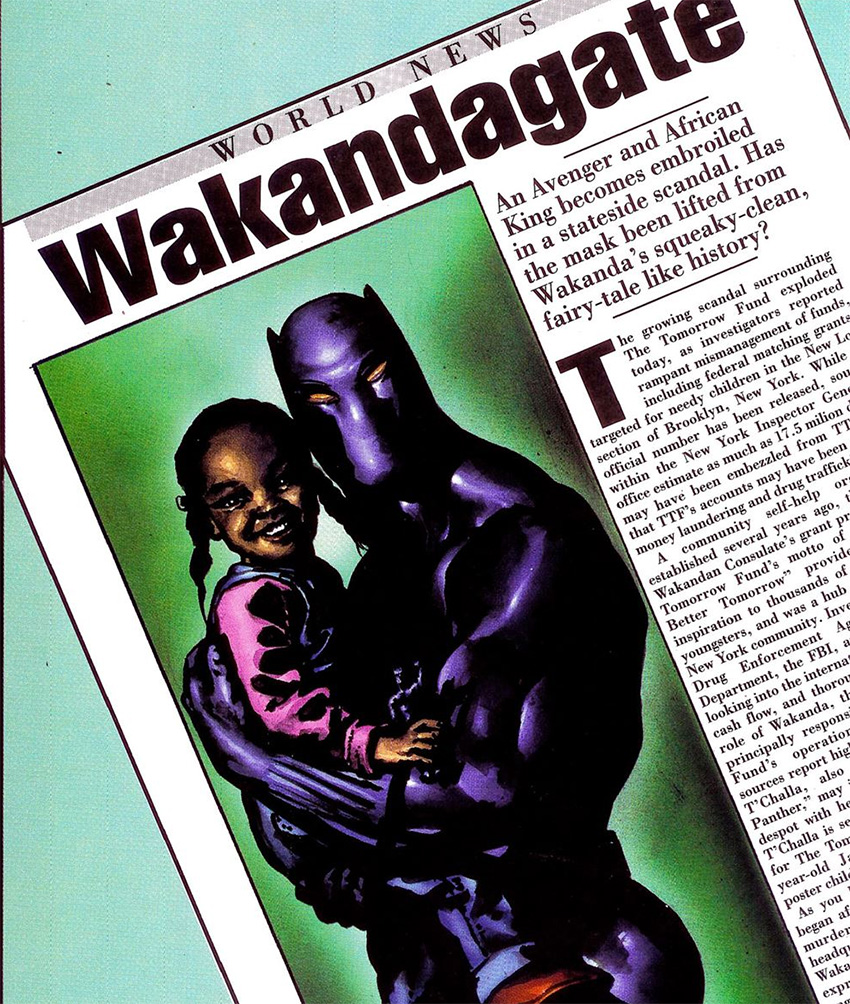
As for why T’Challa’s in town; it all revolves around a recent scandal in his philanthropic Tomorrow Fund. Which has caused him to put aside his kingly duties, including an ongoing ethnic conflict in Wakanda. Needless to say, the Panther’s all business on this trip –and in his actions.
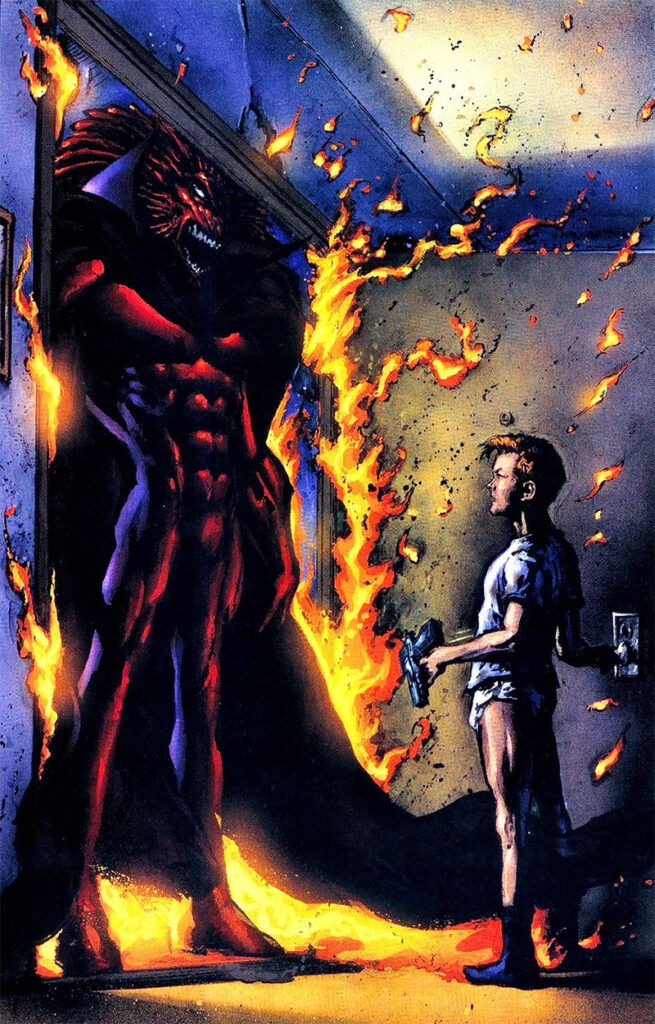
Of course, things are just getting started in this story and title for T’Challa, his crew, and Ross. Yet as it concludes, no less than MEPHISTO arrives at the door. Ross casually looks him over, closes the door and walks away. Very unconventional and unexpected conclusion for what would be a very unconventional and unexpected title.
While it may seemed like this would be a humorous title, it went well beyond that. T’Challa/Black Panther doesn’t mess around and is all business. In previous appearances, he had seemed like a melodramatic combo of Batman, mixed with Thor’s vocabulary, but here he’s slick and stylish in his civilian guise, and darn near pants-pooping intimidating in his Panther gear.
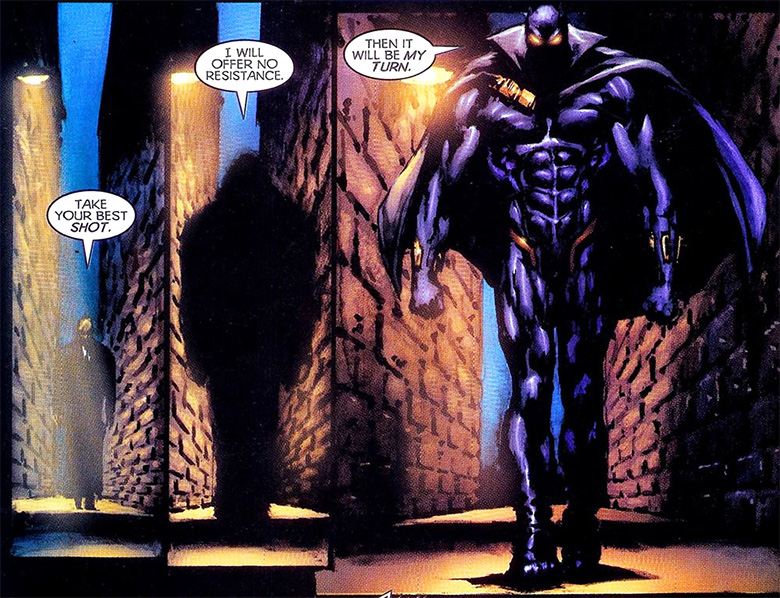
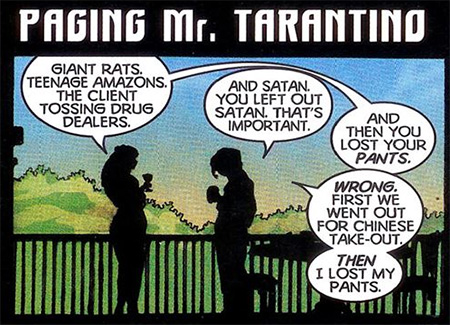
The series explored several very serious themes and stories. Which was part of the intent of the late 90’s “Marvel Knights” banner that this was launched under. It really established T’Challa and Wakanda as serious characters and settings; not just back ground guest stars and plot elements. Later, it was revealed that T’Challa had originall;y joined the Avengers to sort of spy on them for Wakanda’s sake. They alsoincluded another unexpected storyline by tying in Black Panthere’s old “Jungle Action” villainess, Malice, with the the 80’s/90’s Marauders version from “X-Men”. In short, this title dove in, head-first, to the deep end of Wakanda’s waters and was, arguably, the best Black Panther title Marvel ever put out.
It’s entirely possible that Black Panther would’ve never been adapted into a blockbuster movie without this series. Sure, Black Panther first appeared in the 60’s, but he was refined in the late 90’s. Subsequently, a buncha’ office goofs wouldn’t have had a lively lunch conversation in Germany. So when did the Black Panther/Wakanda phenomenon begin? Safe to say it was here.
Summary: King T’challa comes to New York with his supporting cast, gets a new member who loses his trousers. Thugs are beaten. Mephisto knocks on the door.
Cover Price: $1.50
Rating: $2.50